

Hindu Undivided Family (‘HUF’) Deed Format
What is HUF Deed/Affidavit?
HUF stands for Hindu Undivided Family, and a deed is a legal document. A HUF deed is a document primarily created for a Hindu joint family that legally establishes the formation of a Hindu Undivided Family (HUF), the rules for the protection, division, ownership, and management of ancestral property, and details of family members. It serves as proof of the existence of a HUF. HUF Deed format is called by many different names like HUF affidavit format, HUF Certificate, HUF Creation Deed format, HUF Formation Deed format, HUF Setup Deed format etc. but all mean the same. The HUF deed format for PAN card is prepared in accordance with Hindu law and income tax act. In India, the HUF deed format prepared in Word is notarized on stamp paper, which is a legal process of verification. A PAN card is required to prove the existence of a HUF for income tax purposes. Among the steps for HUF registration, creating a HUF deed is the first step, obtaining a HUF PAN card is the second, and opening a bank account after obtaining both is the third and final step in this category.
How to make an HUF deed format in a Word file?
A Hindu Undivided Family (HUF) deed draft is created in accordance with Hindu law and the Income Tax Act. The HUF deed format is first created in a Word file. Details of all family members and coparceners are required to create the HUF deed, as the family members together form the HUF. In a HUF (Hindu Undivided Family), the Karta plays a key role. The Karta is also called the head of the family. To prepare a HUF deed, you should seek the help of an experienced tax expert or professional who is fully versed in HUF deed drafting and its legal rules and compliances.
What is the format of the HUF deed?
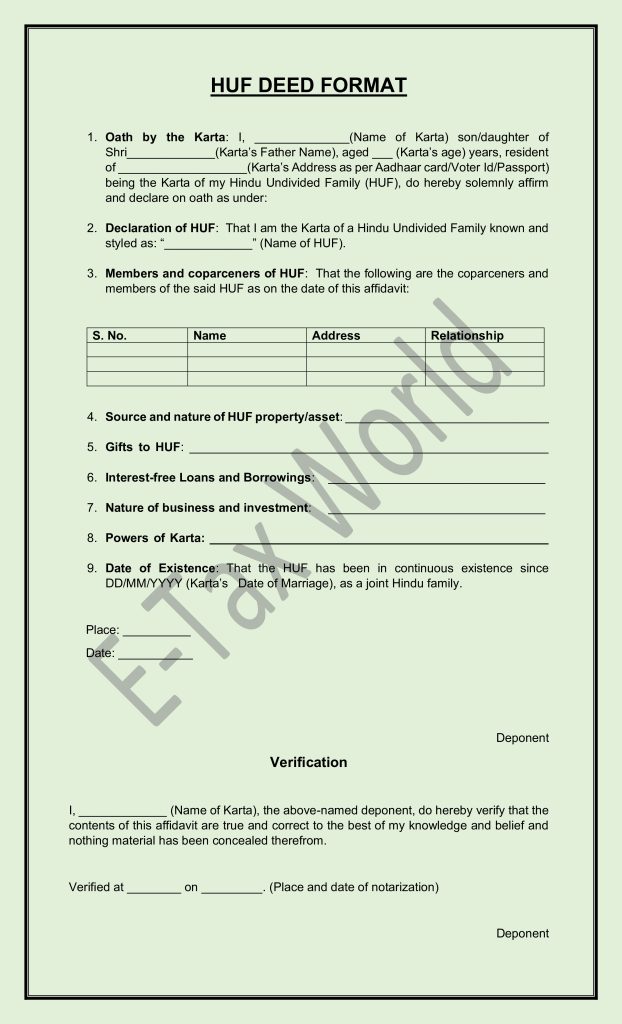
Consists in draft HUF deed word format:
- Oath by the Karta: The HUF deed format is initiated with the oath and declaration of the “Karta” (head of the family). This includes the name of the Karta, father’s name, age, and address.
- Declaration of HUF: To establish the identity of the HUF, it is given a name. This name is used to apply for a PAN card and open a bank account. The word “HUF” is added to the name of the “Karta” to establish the identity and name of the HUF (Karta’s Name + HUF).
Let us understand this with an example: A married individual named Honey Jain aims to establish an HUF as Karta, necessitating a PAN card and an HUF deed. Consequently, his HUF will be referred to as “Honey Jain HUF.”
Along with the name, the current and permanent address of the HUF is also mentioned in the HUF deed format, which is included in all the paperwork done for the HUF.
- Members and coparceners of HUF: Members and coparceners from four generations of the same family can participate in the drafting the HUF deed format. The names of the members and coparceners, their father’s name, address, and relationship with the Karta are mentioned in the HUF deed.
- Source and nature of HUF property/asset: Ancestral wealth and property play a very important key role in HUF. A HUF can accept gifts from relatives under Hindu law and the Income Tax Act, 2025. Inherited property and rights determine the source and nature of HUF. Incorporating the ancestral property and assets of the HUF in the HUF deed format is considered a very important and crucial point, which increases trust among all the family members. Inherited ancestral property can also be a means of corpus creation in HUF.
- Gifts to HUF: An HUF is able to receive gifts, movable or immovable, including money, securities, or property, from its members or relatives, and such receipts form part of the HUF corpus. The HUF gift deed is an important part of this documentation.
- Interest-free Loans and Borrowings: In India, under the Income-tax Act, 2025, and applicable rules, an HUF may obtain interest-free loans and advances from family members, relatives, and non-relatives. Preparing an interest-free loan agreement for an HUF is a necessary and correct procedure for legal compliance and income tax assessment. However, it is not mandatory to take out a loan to create corpus in HUF. This is subject to mutual consent between the members and coparceners, as the income generated is considered the HUF’s own income and helps avoid clubbing of income. Therefore, this is included when drafting the HUF deed format in Word.
- Nature of business and investment: An HUF can have various sources of income and investments and can engage in various activities. If the property is registered in the name of the HUF, the HUF can earn rental income from the house property. The HUF can also earn profits and gains from businesses and professions and obtain a GST registration certificate. An HUF can earn capital gains income by selling shares, securities, equities, mutual funds, properties, etc., transferred in its name. An HUF can earn interest under income from other sources by making a fixed deposit in a bank. The nature of the HUF’s business and investments forms part of the HUF deed format.
- Powers of the Karta (head of the family): The Karta is fully authorized to open, operate, and close bank and demat accounts in the name of the HUF, apply for and manage the PAN of the HUF, file income tax returns (ITR), replies, appeals, and representations, apply for GST registration, MSME (Udyam) registration, and other statutory registrations, sign cheques, applications, agreements, and all documents on behalf of the HUF. The Karta is also eligible to authorize any other members with the mutual consent of the family members. The rights of the Karta must be mentioned prominently in the HUF Deed format.
- Date of Existence: Under Hindu Law, the date of marriage of the Karta is considered the beginning of a Joint Hindu Family. This is prominently mentioned in the draft HUF deed as this date is considered to be the date of incorporation of the Hindu Undivided Family (HUF).
- Place, date, and signature: Finally, the Karta verifies the entire draft HUF deed and signs the deed as a deponent, and mentions the place and date of signing the deed.
- Stamp paper for HUF deed: Stamp duty must be paid to ensure the legal compliance of the HUF deed. Purchasing a stamp paper is a necessary procedure. Complete information regarding stamp duty payment can be obtained from the professional/lawyer drafting the legal HUF deed format.
Is ancestral property declared in a HUF deed format?
Ancestral property refers to property inherited from the father, grandfather, and great-grandfather without any consideration. Such property is family property, often shared and owned by multiple family members. Such property automatically becomes the property of the HUF but is listed in the HUF deed for paperwork, legal, and tax purposes. All family members of the HUF are involved in the division of the property. These properties are the assets of the HUF, which the HUF can rent out or sell to earn capital gains. Accurate information about the property and its division members in the HUF deed format is a sign of reliable, accurate, and precise continuity in the family.
Which family members can be part of the HUF deed format?
The HUF deed includes the Karta and his wife (first generation), the Karta’s daughter, son, and daughter-in-law (second generation), the Karta’s granddaughter, grandson, and grandson’s wife (third generation), and the Karta’s great-granddaughter, great-grandson, and great-grandson’s wife (fourth generation). An HUF may consist of at least one and as many as four generations.
What is the difference between Karta, Members and Coparceners in HUF deed format?
Karta: The senior most member of the family and the person responsible for all the important legal work, necessary responsibilities, decision making and all the paperwork related to signing etc. of the family is called Karta.
Members: The woman who comes into the household as a wives after marriage is called a member of the HUF. The Karta’s wife, son’s wife, grandson’s wife, and great-grandson’s wife are also members of the HUF.
Coparceners: Those individuals within the same family who receive a share in a property division are descendants of the same ancestor and are related by blood. Such individuals are called coparceners in a HUF. The Karta, sons, daughters, grandchildren, and great-grandchildren are all coparceners in a HUF.
If an individual serves as the Karta (head) of their HUF, their parents are unable to join his HUF, since the Karta is acknowledged as the senior member of the HUF. However, the same son will be eligible to join the HUF deed created by his parents.
Is the source of income of the HUF mentioned in the HUF deed format?
After establishing the HUF deed, an application is submitted for a PAN card for the HUF, which acts as essential identification for opening an HUF bank account and for tax-related matters. Only at that point can any transaction or income-related activities commence. If the members of the HUF consent and desire this, the HUF deed can state the activities that the HUF plans to pursue in the future, which will provide income for the HUF. This may involve business, investment, interest, or rent, among others.
How many HUF deeds can be created within one family?
Creating an HUF deed means HUF registration, where it is registered with the Income Tax Department for the purpose of tax benefits or division of property. All married individuals in the same family are eligible to create their own separate HUF. They can create a separate HUF deed, apply for a PAN, open a bank account, file HUF income tax returns (ITR), and receive income tax benefits. A Hindu family can have more than one HUF PAN card and HUF deed, as a HUF is automatically created upon marriage; it simply needs to be formally registered for legal and income tax purposes.
Can a woman act as the Karta in a HUF deed?
Yes, in India, a woman also has equal rights as a man, under which a woman can become the head of the family in the absence of a senior male member. In 2016, a ruling by the Delhi High Court determined that the oldest female member of a Hindu Undivided Family can serve as its ‘Karta’ (manager). The PAN card of HUF can be applied in the name of female Karta. In the HUF formation deed, the female Karta will have all the rights that a male Karta has to manage the HUF. However, it is also true that the wife and daughter-in-law are members of the HUF and do not have any stake in the division of property as per the Hindu Law.
What is the HUF partition deed format?
The legal deed made while dividing the property of HUF among the members and to end the existence of HUF is called HUF Partition Deed. A HUF partition deed is a legal document created with the consent and requirement of the members of the HUF. The HUF Partition Deed contains complete details of the family’s movable and immovable property, the shares to be given to the members and coparceners, its rules, etc. Stamp duty is required to be paid for legal formalities.
For any help regarding HUF Deed Format in India, you can contact us at +91-9958869427.
Also, read- HUF registration services in India
About Author:
Honey Jain
(Tax & Legal Consultant)
Honey Jain is the founder of the renowned tax consulting firm “E-Tax World.” He is a renowned tax and legal consultant. He works to simplify the complexities of taxation through his informative and useful blog.